Beyond Nuclear Family: Recipes for Happiness

12 October 2022 5:00 PM – 27 November 2022 7:00 PM
Display gallery | Dittrichova 9 | Praha 2
www.display.cz
Exhibiting artists: Karolina Balcer, Lizza May David and Claudia Liebel, Kristina Fingerland, Robert Gabris, annette hollywood, Binelde Hyrcan, Charlotte Jarvis in collaboration with Lucy Kirkwood, Signe Johannessen, Agnė Jokšė, Eva Koťátková, Marie Lukáčová, Mary Maggic, Markéta Magidová, MATERNAL FANTASIES, Zoë Claire Miller, Mothers Artlovers, Chiara No, Alanis Obomsawin, Nina Paszkowski, Minh Thang Pham, Anni Puolakka and Ellie Hunter, Vojtěch Radakulan, Janek Rous, Karolína Kripnerová and Vojtěch Sigmund (Artyčok.TV and Architects without Borders), Adam Rzepecki, Jonne Sippola, Jirka Skála, Maja Smrekar, Martina Drozd Smutná
Curators: JCHS curatorial collective (Barbora Ciprová, Veronika Čechová, Tereza Jindrová, Karina Kottová)
Exhibition architecture: Vojtěch Radakulan
Production: Sára Davidová, Ondřej Houšťava, Jakub Lerch (SJCH), Venuše Al Ali Tesner (Display)
Visual identity: Terezie Štindlová & Oriol Cabarrocas
The text brochure for the exhibition can be downloaded here:
Accompanying program – Saturday 15.10. – Agnė Jokšė, annette hollywood, Sophie Lewis
✶15:00
Agnė Jokšė: Dear Friend
✶Dear Friend is a performance by the artist based on a letter-form text written in contemplation of friendship as platonic love between queer women. The work openly speaks about various forms of love, affection and care as well as the fragility of relationships and how it can be determined by physical distance and the passage of time. In a highly sensitive, yet engaged and charged manner, the performance addresses not only the intimacy of a (potential) relationship of the writer and the recipient of the letter, but also touches upon the themes of co-living, displacement, coming-of-age, hidden hierarchies of the LGBTQIA+ communities, closeness and the difference between friendship and kinship.
✶Agnė Jokšė grew up in Vilnius, Lithuania and currently lives and works between Copenhagen and Vilnius. Her main practice lies in writing, which she develops through non-linear, poetic films and videos. Several of her works address the topics of family relations, friendship and kinship, questioning the related gender-based and social stereotypes. Although her works are to a large extend text-based, she is interested in the unsaid, untellable, felt and experienced.
✶16:00 annette hollywood: [anderkawer], screening and artist talk
✶The project [anderkawer] shines light on the situation of non-heteronormative families through the prism of biographies and social-historical events of the past hundred years, bringing changing ideologies of family and motherhood into focus. The search for traces of these families who often, as result of discrimination and fears of punishment, lived covertly, leads into queer and historical archives and is being filmically enacted. annette hollywood presents her cases as time-travelling private detective, starting out with the first wave of homosexuals becoming visible in 1920s Berlin. Not an easy investigation as lesbian mothers stayed well hidden until the 1980s for fears of loosing custody after divorce. Archival documents and found footage tell a story of gradually increasing discussion, social acceptance and legal change towards more visibility of queer families. The vulnerability and social discourse come into focus, producing knowledge about the history of queer families, in particular lesbian mothers, in Germany. The author presents three chapters of her long-term research project [anderkawer], each focusing on one decade of the last century, from the 1920s to the 1940s.
✶annette hollywood is a Berlin-based artist and filmmaker. In her work, she critically and humorously examines social and political issues of our times, such as constructions of power and gender or the distribution of resources and attention. Employing her performative appropriation strategy ‘Performing Found Footage’, through which she interact with pop and mass-cultural phenomena, her works represent deconstructions of mass media formats and offer new perspectives.
✶17:00 Sophie Lewis: Abolish the Family!?
✶While being the site of the vast majority of the world's rapes and murders, the family is also where almost all of us were manufactured. Although very often violent in itself, it is the only thing protecting many of us from the violence of the state, and repairing the damage done to our bodies and souls in the market. For many of us, the family is the only place where we feel cared for. But what if we could change this organization of the world? What if care was not something we expected to receive exclusively from kin? For more than two centuries, revolutionaries (from Charles Fourier to Alexandra Kollontai) and movements (from Wages for Housework to Third World Gay and Lesbian Liberation) have raised the utopian proposal of abolishing the family – defined as the privatization of care into private nuclear households – as part of a wider revolution against capitalism. What can we take from this longstanding critical-utopian, lesbian, black radical, and Marxist-feminist political tradition today?
✶Sophie Lewis is a writer living in Philadelphia, teaching courses on feminism, utopian theory, and anti-work politics at the Brooklyn Institute for Social Research. Her essays - on subjects ranging from domestic labor to trans liberation to octopus eros - have been published in academic journals such as Signs and Feminist Theory as well as non-academic ones such as Boston Review, The New York Times, n+1 and The London Review of Books. Sophie studied English Literature and subsequently Environmental Policy at Oxford University, followed by Politics at the New School for Social Research and Human Geography (for her PhD) at the University of Manchester. She is now a Visiting Scholar at the Alice Paul Center for Research in Feminist, Queer and Transgender Studies at the University of Pennsylvania and tweets at @reproutopia. Her first book was Full Surrogacy Now: Feminism Against Family (Verso Books, 2019) and her second, published in October 2022, will be Abolish the Family: A Manifesto for Care and Liberation (Verso Books and Salvage Editions).
✶Place: Auditorium of the Display Gallery
Dittrichova 9, Praha 2
✶The program will be held in English.✶
Accompanying program – Sunday 16.10., Monday 17.10. – Taka Taka
✶Sunday 16.10.✶
✶16:00 – 19:00
Taka Taka – artist lecture
Panagiotis
Panagiotakopoulos (GR), a.k.a Taka Taka, is the godmother of the drag House of Hopelezz, sister for others, mother of the drag king House of Løstbois, proud daughter of Jennifer Hopelezz and co-founder of the non-profit Drag King Academy Amsterdam . Taka Taka identifies as a dragtivist, educator, queer theorist and independent curator who produces performances as art director for the Amsterdam‘s sex positive underground night club, Church since 2013. They were trained as a professional make-up artist, studied Fine Arts at the Gerrit Rietveld Academie followed by Master in Arts at the Dutch Art Institute. Currently researching drag mothering as an artistic educational model together with DAS support PhD programme THIRD. Taka Taka sees drag as an amplified voice, whose purpose is to communicate, problematize and propose methods according to local conditions. They have shared their knowledge and methodologies for drag mothering, gendered character based practices and its intersections with HIV through interviews, lectures, essays and workshops with various Dutch art institutions and art academies. They collaborated annually with SOA/AIDS Nederland, Global Aids Village, and more. As well with their biological mother Dimitra Panagiotakopoulou who is living in the Greek village Saravali and designing and knitting entire outfits for Taka's lectures and performances.
✶Monday 17.10.✶
10:00 – 17:00 workshop
PARTICIPATION AFTER PREVIOUS REGISTRATION AT THE ADDRESS info@sjch.cz
re-ORGAN-ice our senses.
(play all day till we feel like clay)
✶We welcome the esteemed camp drag queen, scholar and dragtivst Taka Taka to present a one-hour lecture followed by a practical workshop exploring character creation with tools that they have developed from their camp – dragtivist practice, resulting in short performances for and with our characters. The aim of this workshop is to reveal the act of dressing/undressing as an undeniable personal and social engagement by having fun while understanding one’s impact, the realities of character and their production from fingernail to toenail. For this workshop we will use tools from drag to define our performance characters and reflect on the following question: How can we relate to society in order to channel and experience the power and responsibility of getting attention through our altered public image?
(*Drag can be seen for our workshop with a wider lens as a transformation practice of reorganizing oursenses; so drag is a practice far beyond achieving a character- look by instrumenatlizing aesthetics of drag binary performers)
This workshop will consist of a 45-minute lecture and an accompanying workshop on creating drag characters by the use of interactive exercises on paper, face, body, resulting to a character presentation / rehearsal / performance in the end of the day.
✶What to bring:
Basic makeup will be provided, but please bring any make-up or costume pieces you have. As well bring heels or Dr Martens or flip flops :)) wigs, hats, masks are also make-up, and whatever material you would like to place on your character's body or surrounding ...You are especially encouraged to bring that thing in your closet you love but never manage to wear.Or any old or new artwork that can wear on your body:))
Secondly a photographic reference of a character who for some reason talks to you, could be a fantasy character from movie / video game / an animal / someone you admire / a politician you hate or just a photograph which contains some-body.
✶Place: Auditorium of the Display Gallery
Dittrichova 9, Praha 2
✶The program will be held in English.✶
Closing event – Sunday 27.11. – Mothers Artlovers, Tabita Rezaire, Vlaďka Niederhafnerová, alpha nova & galerie futura
Program
✶13:00
Performance by Mothers Artlovers: Dinner Party / in Czech
✶The final performance of the Mothers Artlovers collective for their installation Dinner Party
✶Mothers Artlovers is a group of visual artists, theoreticians, curators and activists – mothers. As part of the Beyond Nuclear Family exhibition, they present their long-term project reflecting various forms and experiences of love, its visibility, as well as social and institutional critique. The authors were loosely inspired by the now iconic work of Judy Chicago from the 1970s, and here, too, the triangular table serves as a site of feminist visions. As presented by Mothers Artlovers, each side of the table represents one form of love: Self-love, self-care and self-worth; Love as partnership; Love at the institutional level, institutional care. A multi-layered installation of ceramic objects, recipes, and actual food takes place on the table, changing over time. Within the closing show, the performance brings the whole installation to life and sets into motion other meanings of "recipes of happiness”.
✶14:00 Tabita Rezaire: Art of Birth + talk with Vlaďka Niederhafnerová / film with English subtitles, talk in Czech
✶Her own path as a doula inspired the artist Tabita Rezaire to gather ancestral teachings from the elders of different communities of French Guiana. Art of Birth blesses us with the transmission of four women who from their respective traditions have supported and cared for the initiation of motherhood: Mrs Yapara from the Indigenous Lokono tradition, Odette and Noria from the Maroon Saramaka tradition, and Mrs Myriam Kerrel from the Creole tradition. Through these testimonies, Tabita shares with us the art and science of birthing from her land and follows in the footsteps of her grandmother and great grandmothers who were both midwives.
✶The screening will be followed by a talk and discussion with Vlaďka Niederhafnerová, a Czech midwife, who will address the topic natural birth and local possibilities, restrictions and experiences with birthing within and beyond the institutional system.
✶16:00 Claims, Quests & Desires. Around the Family Table / in English
✶Round-Table & Think Lab with inputs, discussions, and poster production
hosted by alpha nova & galerie futura, Berlin with artist, activist, and curator Zofia Nierodzińska (until recently Arsenal Municipal Gallery Poznań), artist and activist Jolanta Nowaczyk (Ciocia Czesia) and social worker and activist Hong Van Tran and guests.
✶Claims, Quests & Desires is a series of round tables and think labs in which we repeatedly address different questions around feminist presences and futures and together with invited guests and the participants develop practical activist and cultural strategies for action and forge alliances.
In Prague, we will address the topic of family from a feminist perspective and through particular lenses of people whose experiences and stakes have been commonly marginalized in the heterenormative discourse on reproduction and family. We will address the following questions, among others: What exactly does family mean to us? How do we want to live family and how do we represent it? What forms of kinship, care and support do we need to achieve transformative change and how can we shape them together? What radical potential can we aspire to if we live practices of mothering as a possible action rather than a gendered identity? How can motherhood be understood and lived as a feminist, queer, radical and collective practice?
✶alpha nova & galerie futura is an art and exhibition space in Berlin that works from an emancipatory and feminist perspective at the intersection of art, science and political practice.
The project Beyond Nuclear Family, established by the Jindřich Chalupecký Society, evaluates the family as one of the basic units of togetherness found in human communities. The project is aimed primarily at offering a critical review of the modern, western family model, assessing its historical and contemporary, geographical and cultural, utopian and fictitious alternatives. The nuclear family, defined as the marital partnership of a man and a woman living with their biological children, represents an unwritten status quo in western culture. Although the nuclear family was actually at its prime only for a brief period of time during the economic boom and under specific sociocultural conditions that existed in the 1950s and early 1960s in North America, it has become a kind of a global brand, a yardstick by which we judge all other family constellations. It is a dominant paradigm at the political, social, and educational level, as well as in terms of the rule of law in both European and American context. In the Central European environment, the term (traditional) family has been used dangerously often in recent years by populist and neoliberal politicians, mostly in an attempt to restrict human rights related to reproduction, gender, equal marriage, etc.
The exhibition Beyond Nuclear Family: Recipes for Happiness is the second of three exhibitions and performances of the Jindřich Chalupecký Society on the theme of family in 2022. The spring exhibition Around the Family Table in Berlin’s alpha nova & galerie futura space is now followed by Recipes for Happiness in Prague’s Display Gallery. In November, the project will also be presented at the EFA Project Space in New York. Although each of the exhibitions represents a slightly different perspective, they build on each other conceptually and are also connected in terms of the exhibiting artists who are often represented by different works encompassed within the project. The core of the project consists of works by six Czech artists – Eva Kot'átková, Marie Lukáčová, Markéta Magidová, Vojtěch Radakulan, Jirka Skála and Martina Drozd Smutná. Their works created directly as part of Beyond Nuclear Family are complemented with contributions by a variety of other local and international artists.
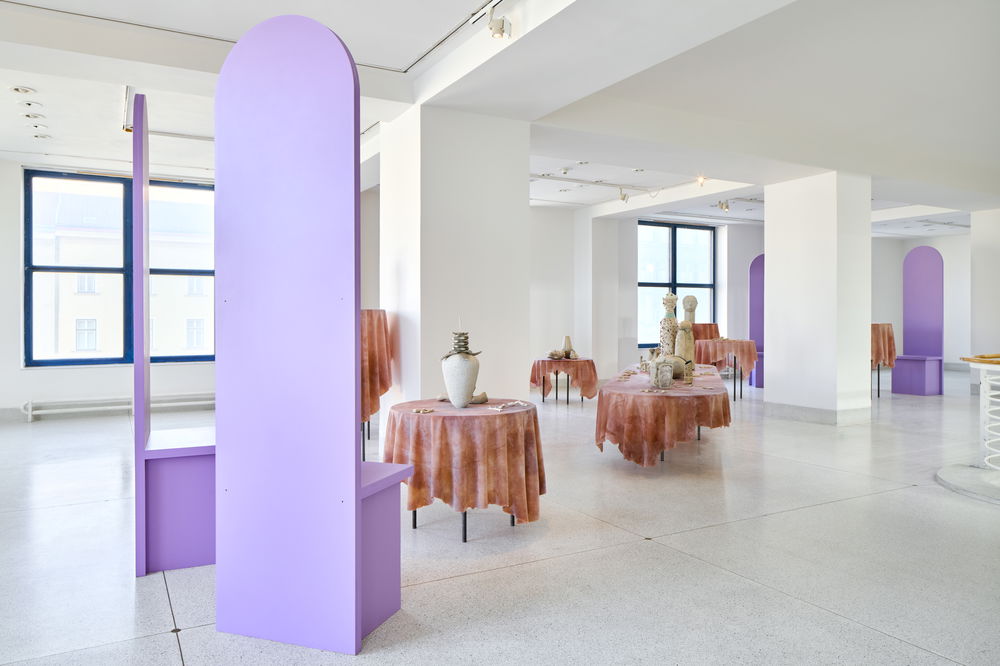
The Prague exhibition entitled Beyond Nuclear Family: Recipes for Happiness provides a complex artistic probe into the various ways of creating and categorizing the family, relationships and roles that its members occupy. The exhibition’s subtitle incorporates the well-established phrase “recipe for happiness” commonly used as a hyperbole, indicating the impossibility of finding a universal recipe for a happy life. By translating this phrase into the plural, we want to express the plurality of forms that different family constellations can take. By means of the installation by the artist collective Mothers Artlovers (in collaboration with the Berlin-based collective MATERNAL FANTASIES), visitors will be given specific recipes and dishes during the exhibition, all relating to the critique of social institutions (also including the concept of family) and relationships. The audience will be able to reflect on these themes at a triangular table reminiscent of the iconic feminist work The Dinner Party by Judy Chicago.
The other works on display – paintings, photographs, videos, texts, textiles, sculptures, performances, and arts research outputs – can also be freely read as possible recipes or (missing) ingredients for (family) happiness. In its totality, the exhibition thus presents a comprehensive and diverse “cookbook”.
Beyond Nuclear Family represents the third phase of the long-term project of the Jindřich Chalupecký Society Islands: Possibilities of Togetherness. It was also organized within the international project Islands of Kinship: A Collective Manual for Sustainable and Inclusive Art Institutions, co-funded by the European Union and Czech Ministry of Culture.


Photo: Radek Brousil
Curatorial text
Fighting the family regime might thus look like several different things: prising the state’s boot off the neck of a “legal” family of “aliens,” for instance, and at the same time offering solidarity to a queer kid in that same family, should she need it, against her parents.
Sophie Lewis, Abolish the Family
The word “family” typically evokes (or at least we are used to thinking it should evoke) things such as closeness, mutuality, care and the warmth of the family hearth. For some, this is indeed what family means, but for many others it is just a kind of desired ideal by which they judge their own, often much harsher, reality. The family has also become a very strong foundation of capitalism. The nuclear family unit is the ideal site for the fulfillment of the imperative of progress, the division between paid or unpaid and better or worse labor, and the rise of the associated gender, class and other inequalities. After all, mom, dad and their children need to live in their own apartment or house, own a washing machine, a dishwasher, a car, a bunch of clothes and toys and a number of other “necessities” that, for the most part, match what the family next door also owns. And if there is a mismatch, it’s often a driving force for greater productivity, so that we can also have everything that those living next to us have and which hopefully makes them happy. It seems that many of us now feel that this is unsustainable. That the economic and consumerist model associated with the ideology of the nuclear family is not beneficial to our planet and carries with it many potentially negative consequences on the social and psychological level. But if happiness is not to be found in the accumulation of commodities and we cannot rely on the nuclear family formula promoted by media and marketing, along with its many gender-based and other stereotypes, where do we, then, look for that happiness or what should we even imagine when we hear that term? And what should we do with our own understanding of family, so that care, happiness and togetherness aren’t just empty words from a butter commercial?
The exhibition Beyond Nuclear Family seeks to provide a critical revision of the modern Western concept of the family and, through the works of more than forty exhibitors, explore the alternatives – historical and contemporary, geographically and culturally specific, utopian and fictional. Although a large segment of society lives in other arrangements, the nuclear family – defined as a married union of a man and a woman living together with their biological children – currently represents the unwritten status quo of our cultural context. At the same time, in a number of non-European cultures and, at the end of the day, even in Christian Europe, family and cohabitation have long been characterized as intergenerational or even outright communal. The short-lived triumph of the nuclear family was ultimately just the period of economic growth and unique socio-cultural conditions of the 1950s and early 1960s in North America. Later, due to economic and cultural reasons, the “ideal”, where it was possible to support a family from the salary of a single “breadwinner”, began to deteriorate fairly rapidly. The nuclear family had shown its darker side. The rise of feminism and the LGBTQAI+ movement and, more generally, the differentiation of society led to a gradual transformation of established roles and entire family systems. Nevertheless, the image of the happy little nuclear family has become a kind of global prototype, a yardstick by which we measure all other (family) constellations. It has also become a dominant paradigm on the political, social and educational level as well as from the point of view of the rule of law, especially in the European and American countries. In recent years, populist and neoliberal politicians in Central Europe have adopted the term (traditional) family as a dog-whistle to push for restricting human rights related to the issues of reproduction, gender, equal marriage, etc.
Beyond Nuclear Family therefore delves into the various ways of creating and naming the family along with the relationships and roles that its members hold within it, while also aiming to deconstruct the dominant image of the family, which is all too often a source of frustration and a tool of manipulation. The subtitle of the exhibition uses the established phrase “recipe for happiness”, which usually functions as hyperbole commenting on the impossibility of finding a single universal guide for achieving a happy life. By transforming this phrase in the plural form of “recipes”, we wish to express the plurality of forms that different family arrangements – as well as systems that go beyond the very concept of family – can have. In the spirit of Sophie Lewis’s recently published book Abolish the Family, we consider what might emerge from the void left behind at the end of “family history”. We do not wish to dismiss those who have genuinely found their happiness within the nuclear family – or those still searching for it there – we wish “only” to undermine the pyramid of social values, on the top of which sits the idealized image of the nuclear family.
Thanks to the installation by the art collective Mothers Artlovers (in collaboration with the Berlin-based collective MATERNAL FANTASIES), visitors to the exhibition will encounter specific recipes and dishes related to the critique of social institutions (which also include the idea of family) and relationships. The audience will be able to reflect on the issues in question at a triangular table reminiscent of Judy Chicago’s iconic feminist work The Dinner Party. Just like this performance-installation, works by Eva Koťátková, Maria Lukáčová, Markéta Magidová, Vojtěch Radakulan, Jirka Skála and Martina Drozd Smutná were also made directly for the Beyond Nuclear Family project. They explore the family through the dreams of children and parents, escaping the gender binary, utopian family revolutions, architecture governing or determining coexistence models, lack of (cultural) capital and the interconnectedness, fragility and ambiguity of relationship patterns. These works as well as those from a host of international artists – whether paintings, photographs, videos, texts, textiles, sculptures, performances or outputs of artistic research – can be loosely interpreted as possible recipes or (missing) ingredients for family, or more broadly, interpersonal happiness. Taken together, the exhibition thus represents a comprehensive and diverse “cookbook”. The exhibition is also made unique through the exhibition architecture and the unifying artistic intervention of Vojtěch Radakulan.
Due to the Covid-19 pandemic, the plan for a one-off exhibition became a three-year project and, in a way, a work of love for the curatorial collective of the Jindřich Chalupecký Society. In 2020, we organized a performance and exhibition pop-up at the Center for Contemporary Arts Prague, which was followed by an online residency on the DGTL FMNSM platform. In the spring of 2022, we presented the exhibition Beyond Nuclear Family: Around the Family Table in Berlin’s alpha nova & galerie futura. The current exhibition at the Display Gallery in Prague, subtitled Recipes for Happiness, was followed by a final iteration at the EFA Project Space in New York in November 2022. Although each of the exhibitions takes a slightly different angle, they follow up on each other both conceptually as well as in terms of the exhibiting artists, who are often represented by different works throughout the project.
Contemporary art in your mailbox
Be the first in the picture. We'll let you know about new projects, exhibitions and other events of Jindřich Chalupecký Society and our partners.