Inclusion and Accessibility in the Exhibition Hay, Straw, Dump

The eco-feminist exhibition Hay, Straw, Landfill, presented at the Václav Špála Gallery from 28 March to 3 May 2023, marked our first experience working with accessible design and public participation.
As part of this exhibition and its related discursive programmes, we initiated a collaboration with the community centred around the Cultural and Community Centre ART in Prague 7 (we will report on this collaboration in an upcoming post). We engaged the community as a group tasked with assessing the accessibility and relevance of the exhibition for this age group (a report on this will follow in a future post), and one of the members also participated as a guest in the accompanying programme (see below). We also made an effort to ensure maximum diversity among the participating artists and artistic approaches.

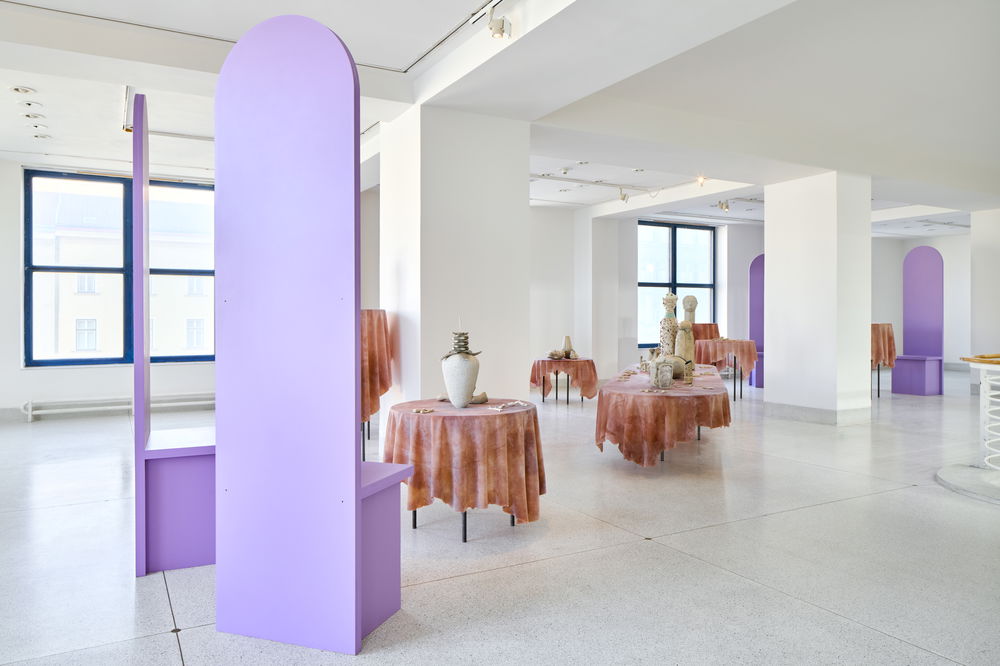
Installation view of the exhibition Hay, Straw, Landfill at the Václav Špála Gallery. Photo: Jan Kolský.
Due to the exhibition design, which did not allow for standard wall labels, we offered printed brochures to visitors. These included curatorial texts on the featured artists as well as a map indicating the placement of individual artworks, some of which were displayed in a fragmentary manner throughout the installation. The brochure was produced in two versions — one written in standard professional language, and the other in a more accessible style. This approach aimed to accommodate visitors for whom art-world jargon might be overly dense. We believe it is possible to discuss complex contemporary issues in a comprehensible language — though, as we discovered ourselves, this is a skill that must be relearned.

Page from the exhibition brochure with a map showing the locations of artworks by the participating artists. Graphic design: Tereza Haspeklová and Petr Kněžek.
An inclusive perspective was also reflected in the design of the accompanying public programmes. In two public discussions, we aimed to translate large global themes into our local context, to make space for groups whose specific situations are often unreflected in mainstream discourse, and who typically lack the social and cultural capital needed to take part in public debate and contribute to its expansion and critique. Our goal was to examine the issue of environmental threats and our relationship to living and non-living nature through an intersectional lens — considering how environmental pollution and the climate crisis disproportionately affect vulnerable groups, such as seniors, people living with physical disabilities, or those pushed to the social margins.
The discursive programme Ecology: Then and Now, a discussion with witnesses and memory-holders on ecological issues through the lens of personal narratives and “big” and “small” histories, sought to explore ecology within a longer historical, local, and gendered perspective. Discourse around ecology often focuses on the present and future, frequently referencing “future generations.” Yet it tends to overlook the perspectives of seniors — both in terms of the specific impacts of environmental issues on this group, and their lived experience and insights. We therefore invited older women to offer the audience a view into contemporary ecological problems through their own observations of environmental change and society’s shifting attitudes toward nature — from the period of state socialism, through experiences of emigration, to the post-1989 era. Their reflections were rooted in intimate, personal relationships to nature and land, but also informed by civic engagement. They shared how certain themes resonated in their lives at different times, depending on their shifting social roles or their involvement in communities such as dissident networks, the underground, or religious groups.
Guests included Terezie Hradilková, Rut Kolínská, and Jarmila Johnová, who were active in the independent environmental movement Prague Mothers (Pražské matky) in the late 1980s (the group has since evolved into the current organisation Walk the City (Pěšky městem). Their perspectives were complemented by dissident Věra Roubalová Kostlánová an the Cultural and Community Centre ART member Jiřina Šedivá.

Discussion “Ecology: Then and Now,” Václav Havel Library, 17 April 2023. Left to right: moderator Martin Babička, and speakers Jiřina Šedivá, Terezie Hradilková, Rut Kolínská, Věra Roubalová Kostlánová, and Jarmila Johnová.
Photo: Jindrich Chalupecky Society

Left to right: Rut Kolínská, Věra Roubalová Kostlánová, and Jarmila Johnová.

Left to right: Terezie Hradilková, Rut Kolínská, and Věra Roubalová Kostlánová.
The second discussion, titled Life on the Landfill: The Problem of Social Exclusion and Environmental Justice, developed the theme of ecology from a socio-political perspective. The issue of environmental justice is not limited to emblematic cases from the global South, where wealthy societies exploit natural resources and local labour, causing economic, political, and ecological harm. The condition in which marginalised populations are pushed into extreme poverty while also disproportionately exposed to environmental degradation caused by industrial production and resource extraction is not solely the result of global geopolitical dynamics — it also takes place within national contexts, including in Central Europe. Environmental reflection must therefore necessarily account for these unequal power relations. In fact, the very concept of environmental justice emerged from the recognition of the link between social inequality and the uneven distribution of environmental harm across different population groups.
In the Czech Republic — and even more so in Slovakia — environmental injustice is closely tied to social exclusion and racial discrimination. National and municipal housing policies often result in residential segregation, most frequently of Roma and other socioeconomically disadvantaged populations. In the Czech Republic, this has involved the forced relocation of Roma residents from historic city centres to peripheral areas near landfills, sewage treatment plants, and the like. In Slovakia, this applies to many long-standing or post-socialist Roma settlements located in areas without access to social, economic, or technical infrastructure. A large proportion of Roma residents in segregated settlements have no access to drinking water, gas, electricity, or sewage systems, and live in environments contaminated by toxins from municipal waste landfills placed near their communities by local authorities.
Participants in the discussion included artist and curator Tamara Moyzes, who drew on the research of other guests to create the work Lactivism: Mycoremediation, presented in the Hay, Straw, Dump exhibition. Roman Matoušek, a specialist in housing geography, contributed insights into environmental and spatial justice and residential segregation (particularly of Roma and foreign nationals) across urban and rural contexts in the Czech Republic. Daniel Škobla, sociologist and social anthropologist, co-author of a study on waste management in Roma-excluded localities in Slovakia, offered broader reflections on ethnicity and class as factors shaping the distribution of environmental risk. Davina Vačkářová, an environmental scientist focused on the political impacts of environmental change — especially in relation to stakeholder engagement and policy-making — contributed to the debate with insights into other intersectional topics in environmentalism, such as gender aspects of ecological change and the inclusion of marginalised groups in sustainability policies.

Nikola Ludlová, moderator, and Daniel Škobla, guest speaker at the discussion Life on the Landfill: Social Exclusion and Environmental Justice, at the Hlína Café Reading Room, Hybernská Campus, 22 April 2023. Photo: Jan Faltus

Left to right: Nikola Ludlová, Roman Matoušek, Tamara Moyzes.

Left to right: Nikola Ludlová, Tamara Moyzes, Roman Matoušek, and Davina Vačkářová.

Left to right: Nikola Ludlová, Tamara Moyzes, Roman Matoušek, Davina Vačkářová, and Daniel Škobla.
With financial support
The reconstruction of the website and information and documentation activities on the Jindrich Chalupecky Society portal in 2025 were made possible thanks to the financial participation of the European Union - Next Generation EU.

Contemporary art in your mailbox
Be the first in the picture. We'll let you know about new projects, exhibitions and other events of Jindřich Chalupecký Society and our partners.